Guides · Colonial period and independence
Colonial Period and Independence: 17 questions, one story from 1607 to 1787
Why the colonists came, who was here first, why they broke with Britain, and the six men who wrote the founding documents. The whole section, with accepted answers.
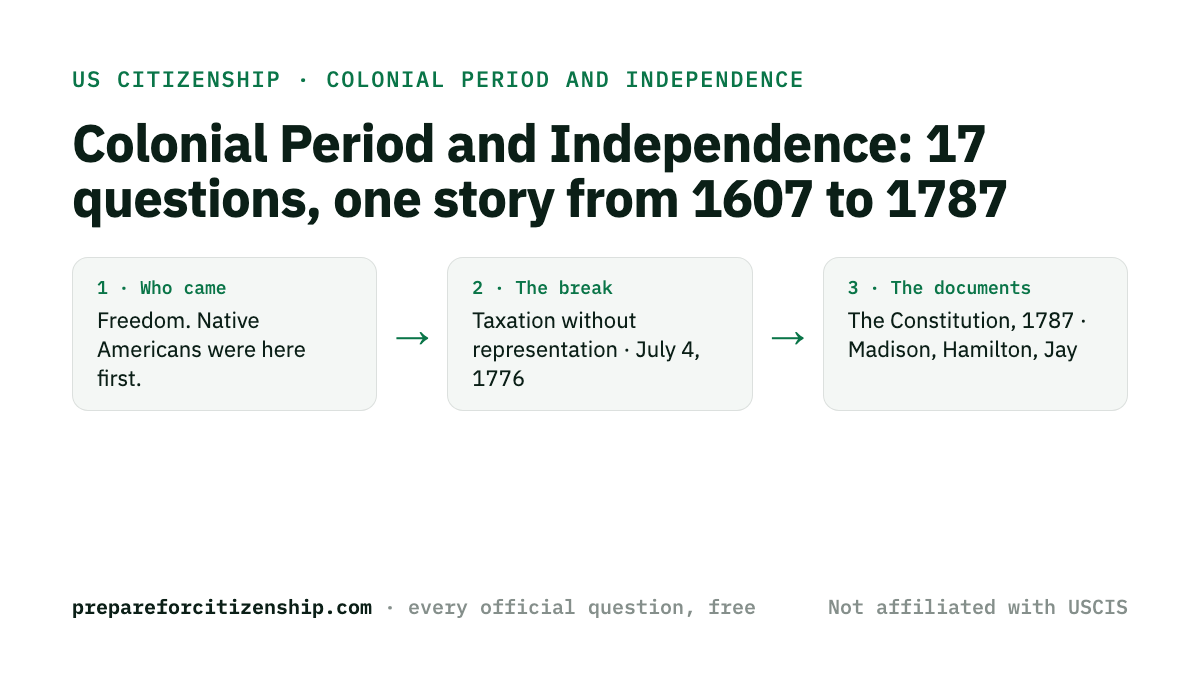
The first history section on the 2025 civics test is seventeen questions that tell one story: people came to the colonies, the colonies broke with Britain, and a handful of men wrote the documents the country still runs on. Learn it as a story with three chapters and the seventeen answers fall into place.
Chapter 1: who was here, and who came
Who lived in America before the Europeans arrived? American Indians, or Native Americans.
The colonists came to America for many reasons. Name one. Freedom. Also accepted: political liberty, religious freedom, economic opportunity, escape from persecution.
What group of people was taken and sold as slaves? Africans, or people from Africa.
Chapter 2: the break with Britain
Name one reason the Americans declared independence from Britain. Taxation without representation. Also accepted: high taxes; British soldiers quartered in American houses; no self-government; the Boston Massacre; the Boston Tea Party; the Stamp Act, Sugar Act, Townshend Acts or Intolerable Acts.
What war did the Americans fight to win independence? The American Revolution. Also accepted: the Revolutionary War, the War for Independence.
Who wrote the Declaration of Independence? Thomas Jefferson. When was it adopted? July 4, 1776.
The American Revolution had many important events. Name one. The Declaration of Independence. Also accepted: Bunker Hill, Washington crossing the Delaware, Saratoga, Valley Forge, the British surrender at Yorktown.
There were 13 original states. Name five. Any five of: New Hampshire, Massachusetts, Rhode Island, Connecticut, New York, New Jersey, Pennsylvania, Delaware, Maryland, Virginia, North Carolina, South Carolina, Georgia. Pick five you can say without thinking, for example the four with "New" plus Virginia.
Chapter 3: the documents and the men who wrote them
What founding document was written in 1787? The Constitution.
The Federalist Papers supported passing the Constitution. Name one writer. Madison. Also accepted: Hamilton, Jay, or the pen name Publius. Why were they important? They helped people understand the Constitution.
Then five "famous for many things" questions, each needing one answer:
- Benjamin Franklin: first Postmaster General. Also: founded the first free public libraries; helped write the Declaration; inventor; diplomat.
- George Washington: first president. Also: Father of Our Country; general of the Continental Army; president of the Constitutional Convention.
- Thomas Jefferson: wrote the Declaration of Independence. Also: third president; the Louisiana Purchase; first Secretary of State.
- James Madison: Father of the Constitution. Also: fourth president; president during the War of 1812; a writer of the Federalist Papers.
- Alexander Hamilton: first Secretary of the Treasury. Also: a writer of the Federalist Papers; helped establish the First Bank of the United States.
The dates that hold it together
Two dates carry the section: 1776, the Declaration, and 1787, the Constitution. Jefferson belongs to the first, Madison to the second, Hamilton and Jay to the papers that got the second one passed. Washington led the war in between. Say that sentence a few times and seventeen questions become one paragraph.
Frequently asked questions
Name one reason the colonists came to America, according to the civics test.
Freedom. Political liberty, religious freedom, economic opportunity and escaping persecution are also accepted.
What founding document was written in 1787?
The U.S. Constitution.
Who wrote the Federalist Papers?
James Madison, Alexander Hamilton and John Jay, under the pen name Publius. Any one of the four is an accepted answer.
Study the official questions, free
Both versions of the civics test, the answers for your state, and practice tests in the real format with the real pass line.
Prepare for Citizenship teaches the test; it does not advise on applications. Anything about your own case belongs with your lawyer or USCIS. Spotted something wrong? Tell us.