Guides · The Constitution
The Constitution section: 15 questions, 5 ideas
Supreme law, We the People, the Bill of Rights, the rule of law and why three branches. The first section of the test, and the ideas that make it one story.
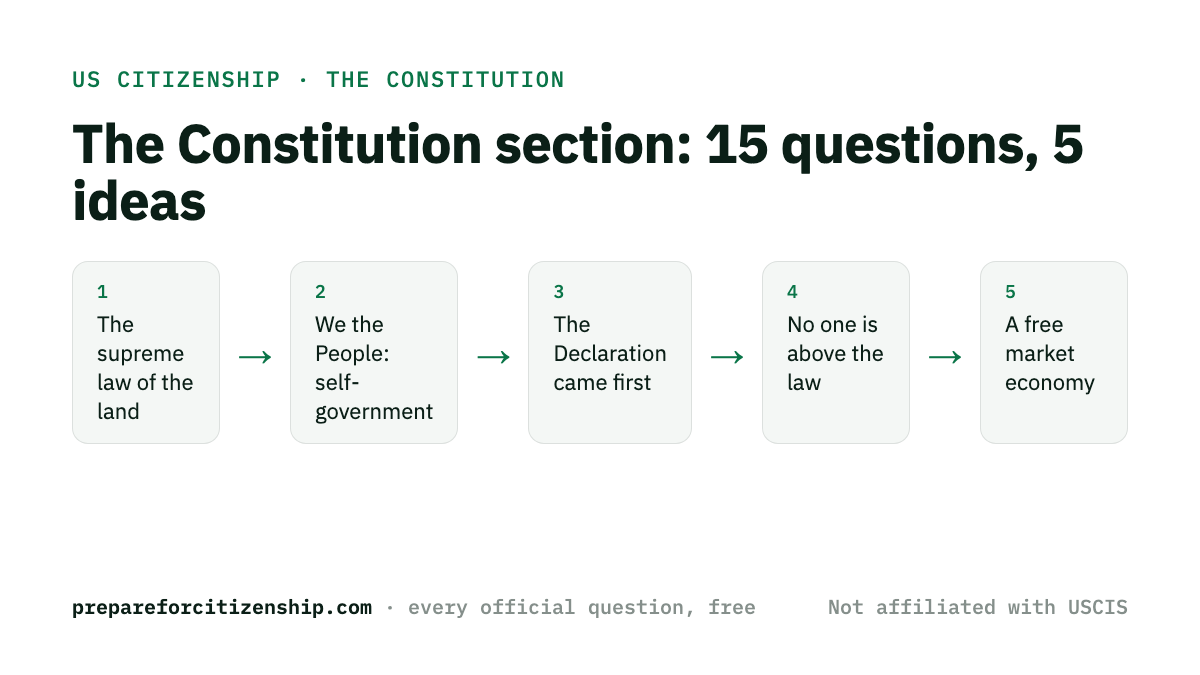
The civics test opens with fifteen questions under Principles of American Government. They look like fifteen facts. They are really five ideas about what the Constitution is and why it is shaped the way it is. Learn the ideas and the fifteen answers follow.
Idea 1: the Constitution is the top of the pile
What is the supreme law of the land? The Constitution.
Name one thing the Constitution does. Forms the government. Also accepted: defines the powers and parts of government; protects the rights of the people.
How are changes made to the Constitution? Amendments.
How many amendments does it have? Twenty-seven.
What does the Bill of Rights protect? The basic rights of Americans, or of people living in the United States.
Idea 2: the people are the source of power
The Constitution starts with "We the People." What does that mean? Self-government. Also accepted: popular sovereignty; consent of the governed; people should govern themselves; social contract.
What is the form of government of the United States? Republic. Also accepted: constitution-based federal republic; representative democracy. All three are on the key, so the republic-or-democracy argument is settled by USCIS: both pass.
Idea 3: the Declaration came first
What founding document said the colonies were free from Britain? The Declaration of Independence.
Why is the Declaration important? It says America is free from British control. Also accepted: it says all people are created equal; it identifies inherent rights.
"Life, Liberty, and the pursuit of Happiness" are in what document? The Declaration of Independence.
Name two important ideas from the Declaration and the Constitution. Equality and liberty. Also accepted: social contract, natural rights, limited government, self-government.
Many documents influenced the Constitution. Name one. The Declaration of Independence. Also accepted: the Articles of Confederation, the Federalist Papers, the Anti-Federalist Papers, the Virginia Declaration of Rights, the Fundamental Orders of Connecticut, the Mayflower Compact, the Iroquois Great Law of Peace.
Idea 4: nobody is above the law
What is the rule of law? No one is above the law. Also accepted: everyone must follow the law; leaders must obey the law; government must obey the law.
There are three branches of government. Why? So one part does not become too powerful. Also accepted: checks and balances; separation of powers.
Idea 5: the economy is left to the market
What is the economic system of the United States? Capitalism, or a free market economy.
Why this section first
Everything later in the test hangs off these fifteen. The three branches section is idea 4 worked out in detail. Rights and Responsibilities is the Bill of Rights in practice. The history sections are the story of how the Declaration became the Constitution. Spend the first evening here and the rest of the test has somewhere to attach.
Frequently asked questions
What is the supreme law of the land?
The U.S. Constitution.
What does "We the People" mean on the civics test?
Self-government. Popular sovereignty, consent of the governed, and social contract are also accepted.
Is the United States a republic or a democracy, according to the civics test?
Both answers are accepted. The key lists republic, constitution-based federal republic, and representative democracy.
Study the official questions, free
Both versions of the civics test, the answers for your state, and practice tests in the real format with the real pass line.
Prepare for Citizenship teaches the test; it does not advise on applications. Anything about your own case belongs with your lawyer or USCIS. Spotted something wrong? Tell us.