Guides · The why questions
The 2025 test asks why. Here are all 17 why-questions and one answer for each.
Seventeen of the 128 questions ask for a reason, not a fact. They are the ones flashcards handle worst, and each has a short accepted answer.
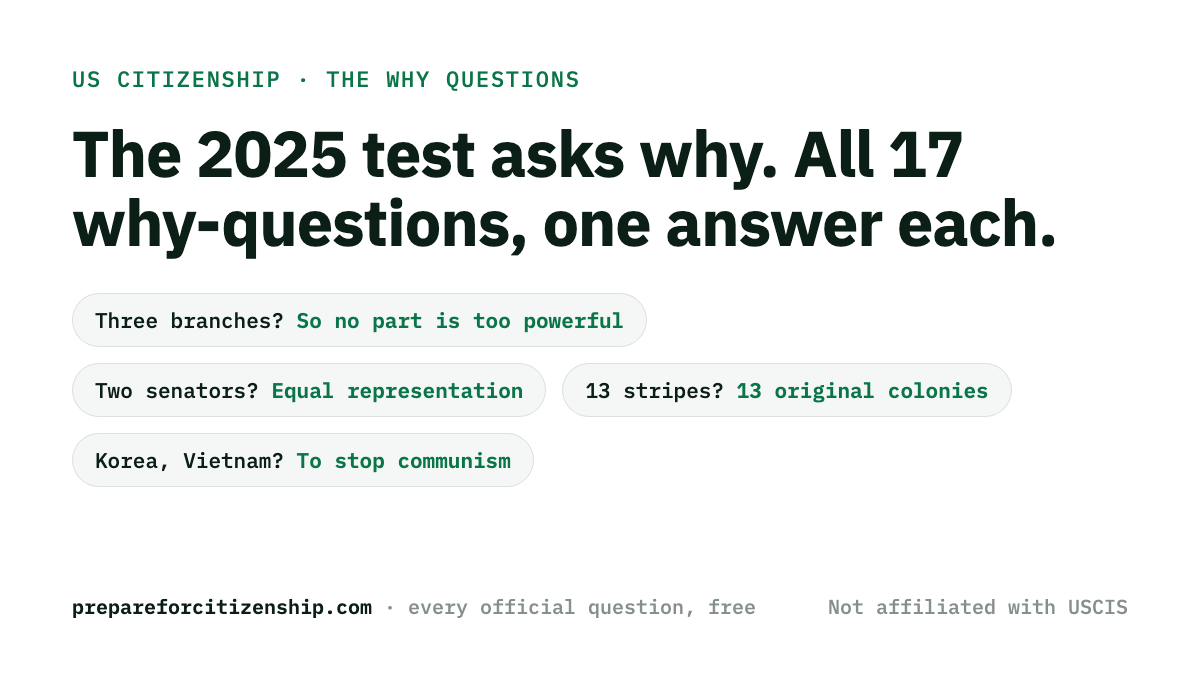
Most civics questions ask for a name, a number or a date. Seventeen questions on the 2025 test ask why. Why three branches? Why two senators per state? Why did the United States enter World War I? These are the questions people freeze on, because a reason is harder to recall than a fact. The good news is that every one has a short accepted answer, and you need only one.
Why they are harder
A fact is either in your memory or not. A reason invites you to explain, and under pressure people explain too much and drift away from the accepted wording. The fix is to treat each why-question exactly like a fact: pick one accepted answer, learn it word for word, and stop talking when you have said it.
Government: how it is built
- There are three branches of government. Why? So one part does not become too powerful. Also accepted: checks and balances; separation of powers.
- Why do U.S. representatives serve shorter terms than U.S. senators? To more closely follow public opinion.
- Why does each state have two senators? Equal representation for small states. Also accepted: the Great Compromise.
- Some states have more representatives than other states. Why? Because of the state's population.
- The President can serve only two terms. Why? Because of the 22nd Amendment. Also accepted: to keep the president from becoming too powerful.
- Why is the Electoral College important? It decides who is elected president.
- Supreme Court justices serve for life. Why? To be independent of politics.
- Why is it important to pay federal taxes? Required by law. Also accepted: all people pay to fund the federal government; civic duty.
The founding documents
- Why is the Declaration of Independence important? It says America is free from British control. Also accepted: it says all people are created equal.
- Why were the Federalist Papers important? They helped people understand the Constitution. Also accepted: they supported passing it.
The wars
Five why-questions ask why the United States entered a war. Learn them as a set, because two share an answer.
- World War I: Because Germany attacked U.S. ships.
- World War II: The bombing of Pearl Harbor.
- The Korean War: To stop the spread of communism.
- The Vietnam War: To stop the spread of communism.
- The Persian Gulf War: To force the Iraqi military from Kuwait.
The flag
- Why does the flag have 13 stripes? Because there were 13 original colonies.
- Why does the flag have 50 stars? One star for each state.
How to drill them
Write the 17 questions on one side of a card and your one chosen answer on the other. Say the answer out loud, in full, then stop. If you catch yourself adding a second sentence, start over. The officer accepts any answer on USCIS's list and needs only one, so the shortest correct sentence is the safest one. How the answer key works.
Frequently asked questions
Why are there three branches of government, according to the civics test?
So one part does not become too powerful. Checks and balances and separation of powers are also accepted answers.
Why does each state have two senators, according to the civics test?
For equal representation, especially for small states. The Great Compromise is also accepted.
Why did the United States enter the Korean War and the Vietnam War?
To stop the spread of communism. That is the accepted answer for both.
Study the official questions, free
Both versions of the civics test, the answers for your state, and practice tests in the real format with the real pass line.
Prepare for Citizenship teaches the test; it does not advise on applications. Anything about your own case belongs with your lawyer or USCIS. Spotted something wrong? Tell us.