Guides · The three branches
The three branches on one page: who writes, who signs, who judges
System of Government is 47 questions, the biggest section on the test. Almost all of it is three branches doing three jobs. The structure, with the accepted answers.
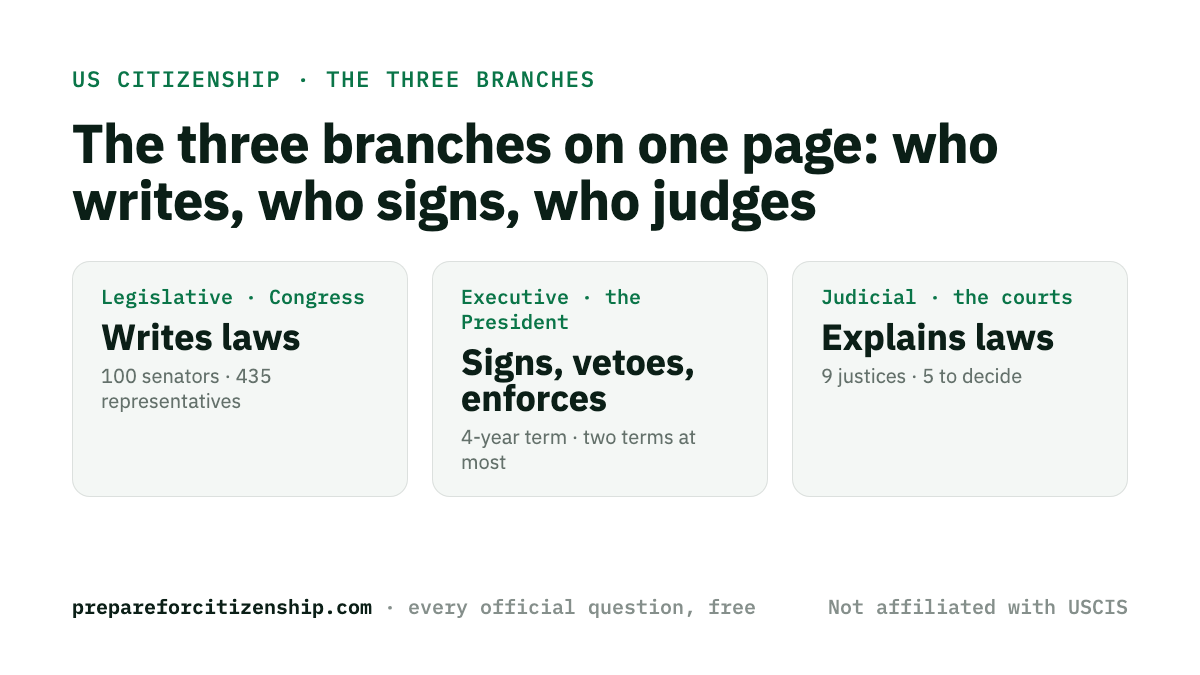
System of Government is the largest section on the 2025 civics test, 47 of the 128 questions. It looks like a wall of facts. It is one diagram: Congress writes the laws, the president signs and enforces them, the courts explain them. Hold the diagram and most of the 47 answer themselves.
The frame
Name the three branches. Legislative, executive and judicial, or Congress, the president and the courts. Which branch is the president in charge of? The executive. What part of the federal government writes laws? Congress.
Congress: writes the laws
- Two parts: the Senate and the House of Representatives.
- One power of Congress: writes laws. Also accepted: declares war; makes the federal budget.
- 100 senators, 2 per state, 6-year terms. Each senator represents the people of their state, who elect them.
- 435 voting members of the House, 2-year terms. Each represents the people of their district, who elect them.
- Why two senators per state? Equal representation for small states. Why do some states have more representatives? Population.
- Why shorter terms in the House? To more closely follow public opinion.
- The Speaker of the House: the current officeholder. Check house.gov the week of your interview.
The president: signs, vetoes, enforces
- Elected for 4 years, at most two terms because of the 22nd Amendment.
- One power of the president: signs bills into law. Also accepted: vetoes bills; enforces laws.
- Who signs bills into law? The president. Who vetoes bills? The president. Who appoints federal judges? The president. Who is Commander in Chief? The president. Four questions, one answer.
- If the president can no longer serve, the Vice President becomes president.
- The executive branch has many parts: the president, the Cabinet, federal departments and agencies. The Cabinet advises the president. Two Cabinet-level positions: Secretary of State and Attorney General, among 22 accepted answers.
- Why is the Electoral College important? It decides who is elected president.
- The President and Vice President: the current officeholders. Check whitehouse.gov.
The courts: explain the laws
- One part of the judicial branch: the Supreme Court. Also accepted: federal courts.
- What does the judicial branch do? Reviews laws. Also accepted: explains laws; resolves disputes about the law; decides if a law goes against the Constitution.
- The highest court: the Supreme Court. Nine seats. Five justices usually needed to decide a case.
- Justices serve for life, to be independent of politics.
- The Chief Justice: the current officeholder. Check supremecourt.gov.
Federal and state
- One power only for the federal government: print money. Also accepted: mint coins; declare war; create an army; make treaties; set foreign policy.
- One power only for the states: provide schooling. Also accepted: police; fire departments; driver's licenses; zoning.
- The 10th Amendment: powers not given to the federal government belong to the states or the people.
- Your governor and your state capital: your own answers. DC residents answer that DC has no governor and no capital.
How to study 47 questions
Draw the three boxes on paper and write the numbers into them: 100, 2, 6 and 435, 2 in Congress; 4 and two terms for the president; 9 and 5 for the Court. Then write the four questions whose answer is simply "the president" under the president box. Then the four names that change, with where to check them. What is left is a handful of why-questions, covered in their own guide.
Frequently asked questions
What are the three branches of government?
Legislative, executive and judicial. Congress, the president and the courts is also accepted.
Who signs bills into law and who vetoes them?
The President of the United States, in both cases.
How many Supreme Court justices are there and how many are needed to decide a case?
Nine seats on the Court, and five justices are usually needed to decide a case.
Study the official questions, free
Both versions of the civics test, the answers for your state, and practice tests in the real format with the real pass line.
Prepare for Citizenship teaches the test; it does not advise on applications. Anything about your own case belongs with your lawyer or USCIS. Spotted something wrong? Tell us.